Bipartisan Infrastructure Law’s $50 Billion Impact on U.S. Environmental Policy in 2026

The Bipartisan Infrastructure Law’s $50 Billion Impact on U.S. Environmental Policy marks a transformative shift toward a greener future.
This monumental federal investment strategically targets clean water, renewable energy, and climate resilience to address long-standing ecological challenges.
Our analysis provides a clear, factual overview of how these funds are being deployed, their immediate and long-term community impacts, and why this legislation serves as a critical benchmark for national sustainability.
Understanding the Bipartisan Infrastructure Law’s Environmental Mandate
The Bipartisan Infrastructure Law, enacted in 2021, allocates an unprecedented level of funding towards critical infrastructure projects, with a significant portion specifically earmarked for environmental initiatives.
This legislative cornerstone reflects a national consensus on the urgent need to address climate change, improve environmental quality, and build more resilient communities.
The $50 billion dedicated to environmental policy underscores a strategic pivot towards sustainable development, moving beyond traditional infrastructure concerns to integrate ecological health into the core of national planning.
This funding is distributed across various programs aimed at clean water, Superfund site remediation, climate resilience, and clean energy transition, demonstrating a holistic approach to environmental stewardship.
As we approach 2026, the initial phases of these programs are already underway, with states and local governments actively applying for and receiving grants.
The law’s mandate is clear: to leverage federal investment to achieve measurable environmental improvements and set a new standard for sustainable infrastructure development throughout the United States.
Key Investment Areas and Their Projected Impact in 2026
The Bipartisan Infrastructure Law channels its substantial environmental funding into several critical areas, each designed to tackle specific challenges and yield tangible benefits.
These investments are not merely about spending money; they are about strategically transforming the nation’s environmental landscape.
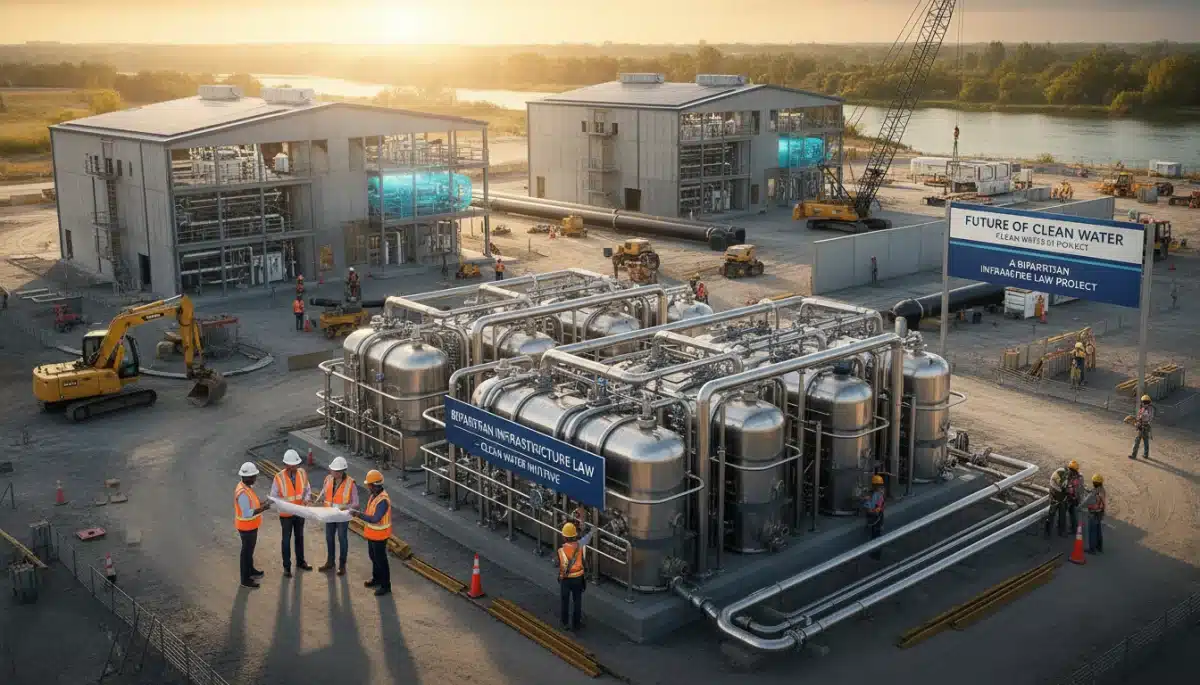
One primary focus is on upgrading and modernizing water infrastructure, ensuring access to clean and safe drinking water for all communities.
This includes replacing lead pipes, improving wastewater treatment facilities, and investing in water recycling and conservation technologies, addressing a fundamental public health and environmental concern.
Another significant portion targets the remediation of contaminated sites, particularly Superfund and brownfield locations, which pose significant health risks and hinder economic development.
By cleaning up these hazardous areas, the law aims to restore ecological integrity and unlock new opportunities for community revitalization, with substantial progress expected by 2026.
Clean Water Infrastructure: A Foundational Investment
The commitment to clean water is a cornerstone of the Bipartisan Infrastructure Law’s environmental agenda.
Billions are allocated to the Drinking Water State Revolving Fund and the Clean Water State Revolving Fund, providing states with the resources necessary to undertake essential projects.
These funds are crucial for addressing the pervasive issue of lead pipes, which continue to threaten public health in countless communities.
The goal is to accelerate the replacement of these hazardous pipes, ensuring that every American has access to safe drinking water, a key objective for the Bipartisan Infrastructure Law’s $50 Billion Impact on U.S. Environmental Policy in 2026.
- Replacing lead service lines in homes and schools.
- Upgrading aging wastewater treatment facilities.
- Investing in stormwater infrastructure to reduce pollution.
- Supporting water conservation and efficiency programs.
Superfund and Brownfield Site Remediation
The cleanup of Superfund and brownfield sites represents a long-overdue investment in environmental justice and public health.
These contaminated areas disproportionately affect low-income and minority communities, and the law provides significant resources to accelerate their remediation.
The Environmental Protection Agency (EPA) is receiving substantial funding to address the backlog of unfunded Superfund sites, moving them towards completion.
This effort will not only remove dangerous pollutants but also pave the way for economic redevelopment and community revitalization in areas previously blighted by contamination, a critical component of the Bipartisan Infrastructure Law’s $50 Billion Impact on U.S. Environmental Policy in 2026.
Climate Resilience and Adaptation Initiatives
Recognizing the escalating impacts of climate change, the Bipartisan Infrastructure Law dedicates substantial resources to enhancing the nation’s climate resilience.
This involves a multifaceted approach to protect communities and infrastructure from extreme weather events, sea-level rise, and other climate-related threats.
Investments are being made in natural infrastructure solutions, such as restoring wetlands and coastal ecosystems, which provide critical buffers against storms and flooding.
Additionally, funding supports infrastructure hardening, making roads, bridges, and utility systems more resistant to climate impacts, a vital aspect of the Bipartisan Infrastructure Law’s $50 Billion Impact on U.S. Environmental Policy in 2026.
These initiatives are designed to build a more adaptable and secure future, reducing the economic and social costs of climate disasters.
By 2026, many of these projects will be well underway, demonstrating tangible progress in safeguarding vulnerable populations and essential services across the country.
Protecting Against Extreme Weather
With increasing frequency and intensity of extreme weather events, the law provides funding for a range of protective measures.
This includes investments in flood mitigation projects, wildfire prevention, and drought resilience strategies, ensuring communities are better prepared for future challenges.
The Federal Emergency Management Agency (FEMA) receives significant allocations for its Building Resilient Infrastructure and Communities (BRIC) program, empowering states and localities to implement proactive resilience projects.
This forward-thinking approach aims to minimize damage and accelerate recovery, reflecting the urgent need for climate adaptation as part of the Bipartisan Infrastructure Law’s $50 Billion Impact on U.S. Environmental Policy in 2026.
- Investing in coastal restoration and protection projects.
- Developing early warning systems for natural disasters.
- Supporting community-led resilience planning and implementation.
- Enhancing forest health and reducing wildfire risks.
Advancing Clean Energy and Transportation
While not exclusively environmental, significant portions of the law’s funding for clean energy and transportation directly contribute to environmental goals by reducing greenhouse gas emissions.
Investments in electric vehicle charging infrastructure, clean public transit, and renewable energy deployment are critical for decarbonizing the economy.
The law supports the development of a national network of EV charging stations, accelerating the transition to electric vehicles and reducing reliance on fossil fuels.
Furthermore, funding for clean school buses and ferries will improve air quality in urban areas, yielding immediate health benefits and contributing to the broader objectives of the Bipartisan Infrastructure Law’s $50 Billion Impact on U.S. Environmental Policy in 2026.
Implementation Challenges and Opportunities by 2026
Implementing a program of this magnitude is not without its challenges, yet it also presents immense opportunities for innovation and collaboration.
The sheer scale of the investment requires meticulous planning, effective coordination across multiple government agencies, and robust engagement with state and local partners.
One significant challenge lies in ensuring equitable distribution of funds, prioritizing communities that have historically been underserved or disproportionately affected by environmental hazards.
The law emphasizes environmental justice, aiming to direct resources to those who need them most, a complex but vital undertaking.
Opportunities abound for job creation, technological advancement, and the development of new green industries.
The Bipartisan Infrastructure Law’s $50 Billion Impact on U.S. Environmental Policy in 2026 is poised to stimulate economic growth while simultaneously addressing critical environmental needs, fostering a more sustainable and prosperous nation.
Navigating Bureaucracy and State-Level Engagement
The successful deployment of these funds hinges on efficient navigation of federal and state bureaucratic processes.
Agencies are working to streamline application procedures and provide technical assistance to ensure that projects can move forward expeditiously.
States play a crucial role in identifying priority projects, securing funding, and overseeing implementation.
Collaborative efforts between federal, state, and local entities are essential to overcome potential bottlenecks and ensure that the benefits of the Bipartisan Infrastructure Law’s $50 Billion Impact on U.S. Environmental Policy in 2026 are realized across the country.

Economic and Social Benefits of Environmental Investments
Beyond the direct environmental improvements, the Bipartisan Infrastructure Law’s investments are expected to generate significant economic and social benefits.
These include job creation, reduced healthcare costs, and enhanced community well-being, demonstrating a holistic return on investment.
The development and implementation of green infrastructure projects will create thousands of jobs in construction, engineering, manufacturing, and related sectors.
This economic stimulus is particularly valuable in communities seeking to transition away from traditional industries, offering new pathways to prosperity.
Improved air and water quality will lead to tangible public health benefits, reducing incidences of respiratory illnesses, waterborne diseases, and other environmental health issues.
These health improvements translate into lower healthcare costs and a higher quality of life for millions of Americans, directly showcasing the Bipartisan Infrastructure Law’s $50 Billion Impact on U.S. Environmental Policy in 2026.
Job Creation and Green Economy Growth
The push for sustainable infrastructure and clean energy technologies is a powerful engine for economic growth.
The Bipartisan Infrastructure Law is catalyzing the expansion of the green economy, fostering innovation and creating a new generation of skilled jobs.
From manufacturing electric vehicle components to designing advanced water treatment systems, the demand for specialized labor and expertise is soaring.
This investment in human capital and technological innovation is a critical long-term benefit, ensuring the United States remains competitive in the global green economy, a core outcome of the Bipartisan Infrastructure Law’s $50 Billion Impact on U.S. Environmental Policy in 2026.
- Growth in renewable energy sector employment.
- Increased demand for environmental engineering and consulting services.
- New manufacturing jobs for sustainable materials and technologies.
- Training programs for green infrastructure construction and maintenance.
Long-Term Vision for U.S. Environmental Policy
The Bipartisan Infrastructure Law’s $50 Billion Impact on U.S. Environmental Policy in 2026 is not merely a short-term spending spree; it represents a foundational shift in the nation’s approach to environmental governance.
This legislation lays the groundwork for a more proactive, integrated, and resilient environmental framework for decades to come.
The investments made now are designed to yield enduring benefits, establishing new standards for infrastructure development and environmental protection.
By addressing systemic issues such as aging water systems and climate vulnerability, the law aims to prevent future crises rather than simply reacting to them.
This long-term vision is about building a sustainable future, where economic prosperity and environmental health are mutually reinforcing.
The momentum generated by these investments in 2026 and beyond will be crucial in shaping a greener, more secure America, demonstrating the profound and lasting influence of the Bipartisan Infrastructure Law’s $50 Billion Impact on U.S. Environmental Policy in 2026.
Building a Legacy of Sustainability
The law’s environmental provisions are expected to leave a lasting legacy, transforming how infrastructure projects are conceived, designed, and executed.
Integrating environmental considerations into every stage of development will become the new norm, fostering a culture of sustainability.
This includes promoting innovative technologies, encouraging public-private partnerships, and fostering greater community involvement in environmental decision-making.
The goal is to create a more resilient nation capable of adapting to future environmental challenges, reinforcing the monumental Bipartisan Infrastructure Law’s $50 Billion Impact on U.S. Environmental Policy in 2026.
| Key Focus Area | Projected Impact by 2026 |
|---|---|
| Clean Water Infrastructure | Significant progress in lead pipe replacement and wastewater treatment upgrades. |
| Site Remediation | Accelerated cleanup of Superfund and brownfield sites, reducing health risks. |
| Climate Resilience | Enhanced protection against extreme weather through natural and built infrastructure. |
| Clean Energy Transition | Expansion of EV charging networks and clean public transit options. |
Frequently Asked Questions About the Bipartisan Infrastructure Law’s Environmental Impact
The primary goal is to modernize and fortify the nation’s infrastructure while simultaneously addressing critical environmental challenges. This includes ensuring clean water, remediating contaminated sites, bolstering climate resilience, and advancing clean energy initiatives, all contributing to a healthier and more sustainable future across the U.S.
The law allocates significant funds to replace lead service lines, upgrade aging water and wastewater treatment facilities, and invest in stormwater management. These efforts aim to ensure access to safe drinking water and improve overall water quality nationwide, directly impacting public health and environmental integrity by 2026.
It funds projects that protect communities from the impacts of climate change, such as extreme weather and sea-level rise. This involves investments in natural infrastructure like wetlands restoration and hardening critical infrastructure to withstand climate-related events, making communities more adaptable and secure.
Absolutely. The environmental investments are expected to create thousands of jobs in green industries, stimulate economic growth, and reduce healthcare costs due to improved environmental quality. These benefits extend to community revitalization and technological innovation, fostering a robust green economy.
The law prioritizes directing resources to historically underserved communities that have disproportionately borne the brunt of environmental pollution. Funding for Superfund and brownfield cleanups, along with clean water initiatives, aims to rectify past injustices and ensure equitable access to a healthy environment for all, a key aspect of the Bipartisan Infrastructure Law’s $50 Billion Impact on U.S. Environmental Policy in 2026.
Looking Ahead: The Enduring Impact
The Enduring Impact The Bipartisan Infrastructure Law’s $50 Billion Impact on U.S. Environmental Policy in 2026 is more than a financial commitment; it’s a strategic investment in the nation’s future.
The initiatives set in motion by this legislation are poised to deliver tangible environmental improvements, foster economic growth, and build more resilient communities.
As these projects mature, their cumulative effect will redefine America’s environmental landscape, establishing a new benchmark for sustainable infrastructure and ecological stewardship.
For ongoing updates on project developments, you can visit the EPA Infrastructure Page.
The coming years will reveal the full scope of this transformative effort, highlighting the critical importance of continued public and private sector collaboration to sustain this momentum.