US Businesses Local Sourcing: Cutting Carbon by 20% by 2026

U.S. companies are accelerating local procurement to build supply chain resilience and meet key emissions targets.
Sustainable Supply Chains: How US Businesses Are Reducing Carbon Footprints by 20% Through Local Sourcing in 2026 examines the operational shifts, regional sourcing strategies, and transport emission cuts driving this 20% reduction across domestic industries.
The Drive Towards Local Sourcing: A Strategic Imperative
US businesses are increasingly recognizing local sourcing not merely as a trend but as a fundamental strategic imperative.
This shift is driven by a confluence of factors, including growing consumer demand for sustainable products and the economic advantages of shortened supply chains.
The goal is to foster greater resilience against global disruptions, a lesson sharply learned from recent geopolitical and health crises.
By sourcing closer to home, companies can mitigate risks associated with international logistics and unforeseen events, ensuring more stable operations.
Furthermore, local sourcing directly contributes to community development and job creation within the United States. This creates a positive feedback loop, strengthening local economies while simultaneously addressing environmental concerns.
Economic Benefits of Proximity
Reduced transportation costs are a primary economic driver for adopting local sourcing strategies. Shorter distances mean lower fuel consumption, fewer logistical complexities, and ultimately, a more cost-effective supply chain.
This efficiency translates into improved profitability and competitive advantage for businesses. Companies can respond more quickly to market demands, reduce lead times, and enhance overall operational agility.
Moreover, fostering relationships with local suppliers can lead to more collaborative innovation and tailored solutions. This close partnership often results in higher quality inputs and a better understanding of regional market needs.
Environmental Impact: Carbon Footprint Reduction
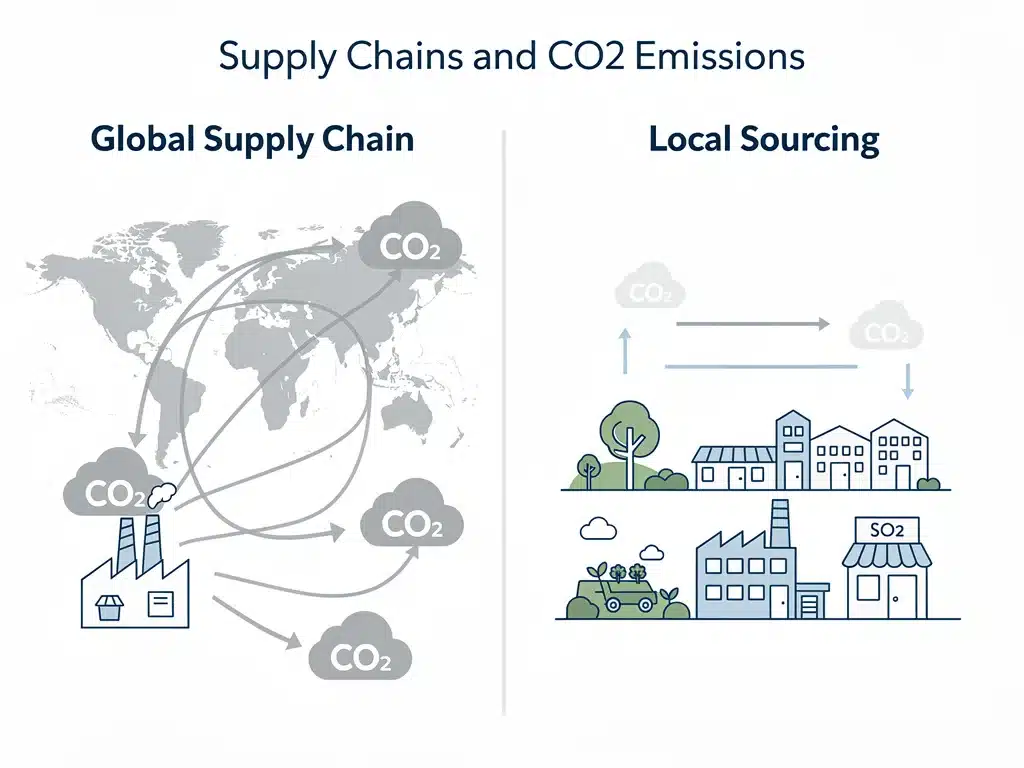
The environmental gains from local sourcing are substantial, particularly in reducing greenhouse gas emissions. Transportation accounts for a significant portion of a typical supply chain’s carbon footprint, and minimizing this aspect is crucial.
By shortening transit routes, companies drastically cut down on fuel consumption and associated carbon dioxide releases.
This direct action aligns with national and global efforts to combat climate change, showcasing corporate commitment to sustainability.
The commitment to US Sustainable Sourcing 2026 targets a 20% reduction in carbon footprint, a testament to the measurable environmental benefits of this approach.
This ambitious goal reflects a serious dedication to environmental stewardship.
Challenges and Opportunities in US Sustainable Sourcing 2026
While the benefits of local sourcing are clear, businesses face various challenges in fully implementing these strategies. Overcoming established global supply networks requires significant investment and strategic realignment.
Identifying and vetting suitable local suppliers with the capacity and quality standards needed can be a complex process. This often involves developing new partnerships and sometimes helping smaller local businesses scale their operations.
Despite these hurdles, the opportunities for innovation and market differentiation are immense. Companies that successfully navigate these challenges will emerge as leaders in sustainable business practices.
Overcoming Supply Chain Inertia
Decades of globalization have created deeply entrenched international supply chains that are not easily dismantled. Businesses must invest in thorough analysis to identify which components or materials can be realistically sourced locally.
This transition demands a comprehensive understanding of existing supplier relationships and the potential for disruption during the shift. Strategic planning is essential to ensure continuity of operations while reconfiguring supply networks.
Companies are adopting phased approaches, initially focusing on high-impact areas where local alternatives are readily available. This gradual transition helps manage risk and build confidence in the new sourcing models.
Investment in Local Infrastructure and Partnerships
For US businesses to achieve the US Sustainable Sourcing 2026 goal, significant investment in local manufacturing and agricultural infrastructure is often required.
This can include upgrading facilities, adopting new technologies, and training a skilled workforce.
Building strong, collaborative partnerships with local suppliers is equally critical. These relationships extend beyond transactional exchanges, involving shared goals, mutual support, and joint problem-solving to ensure long-term success.
Government incentives and public-private partnerships are playing a vital role in de-risking these investments and accelerating the development of robust local supply ecosystems.
These collaborations are key to fostering a supportive environment for sustainable sourcing.
Technological Innovations Driving Local Sourcing
Technological advancements are pivotal in enabling the widespread adoption of local sourcing strategies for US businesses.
Digital platforms and data analytics are transforming how companies identify, engage with, and manage local suppliers.
Blockchain technology, for instance, is enhancing transparency and traceability within localized supply chains. This allows businesses to verify the origin and sustainability credentials of their products with greater accuracy.
Furthermore, automation and advanced manufacturing techniques are making local production more competitive, reducing the cost differentials that historically favored offshore manufacturing.
This helps in achieving the US Sustainable Sourcing 2026 objectives.
Data Analytics for Supplier Vetting
Big data analytics provides powerful tools for assessing potential local suppliers based on various criteria, including sustainability performance, production capacity, and financial stability.
This moves beyond traditional vetting methods, offering deeper insights.
Companies can use data to predict supply chain risks and optimize logistics within a local framework. This proactive approach helps in building more resilient and efficient localized networks.
The ability to quickly analyze vast amounts of data enables businesses to make informed decisions about their sourcing strategies, ensuring that local partnerships are both effective and sustainable.
Automation and Advanced Manufacturing
The rise of automation, robotics, and 3D printing is significantly lowering the cost of production in high-wage countries like the United States.
This makes local manufacturing an increasingly viable and attractive option for many industries.
These technologies allow for greater customization, faster prototyping, and reduced waste, all of which contribute to both economic efficiency and environmental sustainability.
They empower businesses to produce goods closer to their consumer base.
Investing in these advanced manufacturing capabilities is crucial for businesses committed to US Sustainable Sourcing 2026.
It helps close the cost gap with international competitors while simultaneously reducing carbon footprints through localized production.
Policy and Regulatory Support for Sustainable Sourcing
Government policies and regulatory frameworks play a critical role in incentivizing and supporting US businesses in their transition to local sourcing.
These measures can create a more favorable environment for sustainable supply chains.
Tax credits, grants, and subsidies for businesses that invest in local production and sustainable practices are becoming more common.
These financial incentives help offset the initial costs associated with reconfiguring supply chains.
Furthermore, clear regulatory guidelines on environmental reporting and sustainability standards encourage companies to prioritize local, lower-carbon options. This creates a level playing field and promotes responsible business conduct.
Government Incentives and Programs
Federal and state governments are introducing a range of programs designed to bolster domestic manufacturing and agriculture.
These initiatives often include funding for research and development into sustainable production methods.
Loan guarantees and preferential procurement policies for locally sourced goods are also being implemented to stimulate demand and support local suppliers.
This provides a crucial boost for businesses looking to shift their sourcing strategies.
These government-backed programs are essential catalysts for achieving the ambitious targets outlined in US Sustainable Sourcing 2026, by reducing financial barriers and fostering a supportive ecosystem for localized production.
Evolving Environmental Regulations
Stricter environmental regulations, particularly concerning carbon emissions and waste management, are pushing businesses towards more sustainable practices. Local sourcing often offers a more direct path to compliance.
Reporting requirements for Scope 3 emissions, which include supply chain emissions, are becoming more stringent. This directly incentivizes companies to reduce the environmental impact of their logistics and procurement.
The evolving regulatory landscape encourages businesses to proactively seek out local, environmentally friendly solutions. This helps them not only comply with current laws but also anticipate future environmental standards.
Case Studies: US Businesses Leading the Way
Several US businesses are already demonstrating significant progress in reducing their carbon footprints through localized supply chains. These early adopters provide valuable insights and blueprints for others looking to follow suit.
From agriculture to manufacturing, companies are finding innovative ways to source materials and components domestically, proving that the US Sustainable Sourcing 2026 goal is achievable.
Their successes highlight the practical application of sustainable principles.
These case studies serve as powerful examples, illustrating how strategic planning, technological investment, and strong local partnerships can lead to both environmental benefits and enhanced business performance.
Food and Beverage Sector Innovations
Many food and beverage companies are increasingly partnering with local farms and producers to shorten their supply chains. This not only reduces transportation emissions but also ensures fresher ingredients and supports local economies.
Breweries sourcing local hops and grains, or restaurants emphasizing farm-to-table menus, are prime examples. These initiatives resonate strongly with consumers who prioritize freshness, quality, and sustainability.
The sector’s move towards local sourcing is a significant contributor to the overall carbon reduction effort, making a tangible impact on the environmental footprint of everyday consumables.
Manufacturing Sector’s Re-shoring Efforts
A growing number of US manufacturers are re-shoring production, bringing facilities back to the United States.
This trend is driven by a desire for greater control over quality, reduced lead times, and the environmental benefits of localized production.
Companies are investing in advanced automation to make domestic manufacturing competitive, producing goods closer to their consumer base.
This strategy directly contributes to the carbon reduction targets by minimizing long-distance shipping.
These re-shoring efforts are vital for strengthening the domestic industrial base while simultaneously advancing the goals of US Sustainable Sourcing 2026.
It represents a significant paradigm shift in how goods are produced and distributed.

Measuring and Reporting Carbon Footprint Reductions
Accurate measurement and transparent reporting are crucial for validating the impact of local sourcing initiatives on carbon footprint reduction.
Companies must implement robust methodologies to track their progress towards the 20% target.
This involves comprehensive lifecycle assessments and detailed emissions accounting across the entire supply chain.
Standardized metrics and independent verification are essential to ensure credibility and build stakeholder trust.
The ability to clearly articulate environmental achievements also serves as a powerful marketing tool, attracting environmentally conscious consumers and investors.
This reinforces the business case for US Sustainable Sourcing 2026.
Lifecycle Assessment Methodologies
Lifecycle assessments (LCAs) are gaining prominence as a holistic method to evaluate the environmental impact of products and processes from raw material extraction to end-of-life.
This provides a comprehensive view of carbon emissions.
By applying LCAs, businesses can pinpoint specific areas within their localized supply chains where carbon reductions are most effective.
This data-driven approach ensures that efforts are directed towards maximum impact.
These methodologies are fundamental for accurately quantifying the environmental benefits of local sourcing. They allow for verifiable claims regarding carbon footprint reductions and contribute to overall transparency.
Transparency and Stakeholder Engagement
Openly reporting on carbon reduction progress fosters trust among customers, investors, and regulatory bodies. Transparent communication about sustainability efforts is becoming a non-negotiable aspect of corporate responsibility.
Engaging stakeholders, including employees, suppliers, and local communities, in the sustainability journey also enhances buy-in and collaboration. This collective effort is vital for achieving ambitious environmental goals.
Businesses committed to US Sustainable Sourcing 2026 are finding that transparent reporting not only meets compliance requirements but also strengthens their brand reputation and market position.
The Future Outlook for US Sustainable Sourcing
The momentum behind local sourcing and carbon footprint reduction in US businesses is expected to accelerate in the coming years. The 20% reduction target by 2026 is just an initial milestone in a larger, ongoing transformation.
Continued innovation in technology, evolving consumer preferences, and increasing regulatory pressure will further cement local sourcing as a standard business practice.
The focus will shift towards optimizing these localized networks for even greater efficiency and sustainability.
This sustained commitment to US Sustainable Sourcing 2026 will not only benefit the environment but also enhance the competitiveness and resilience of the American economy on a global scale.
Long-Term Vision Beyond 2026
While 2026 marks a significant milestone, the long-term vision for US sustainable sourcing extends far beyond this target. Businesses are already planning for deeper carbon reductions and more integrated circular economy principles.
The focus will likely expand to include broader environmental impacts, such as water usage, waste generation, and biodiversity protection within local supply chains. This holistic approach aims for truly regenerative business models.
The initial successes and lessons learned from achieving the US Sustainable Sourcing 2026 goals will pave the way for even more ambitious sustainability targets in the decades to come.
Global Competitiveness Through Sustainability
Embracing sustainable supply chains and local sourcing is not just about environmental responsibility; it’s also about enhancing global competitiveness.
Companies with lower carbon footprints are increasingly favored by international markets and consumers.
Sustainable practices can lead to operational efficiencies, cost savings, and a stronger brand image, providing a distinct advantage in a crowded global marketplace. This positions US businesses as leaders in responsible commerce.
The commitment to US Sustainable Sourcing 2026 is therefore a strategic move that bolsters both environmental protection and economic prosperity, ensuring a resilient and competitive future for American industries.
| Key Point | Brief Description |
|---|---|
| 20% Carbon Reduction | US businesses target significant carbon footprint reduction by 2026 via local sourcing. |
| Local Sourcing Benefits | Enhanced supply chain resilience, reduced transport costs, and community support. |
| Technological Drivers | Data analytics, automation, and advanced manufacturing facilitate local production. |
| Policy & Incentives | Government support and regulations are crucial for accelerating the transition. |
Frequently Asked Questions About US Sustainable Sourcing 2026
The primary goal is for US businesses to reduce their carbon footprints by 20% by 2026 through strategic adoption of local sourcing. This initiative aims to minimize environmental impact while strengthening domestic supply chains and fostering economic resilience across various sectors.
Local sourcing significantly reduces carbon emissions by minimizing the distances goods and materials travel. Shorter transportation routes mean less fuel consumption and fewer greenhouse gas emissions, directly contributing to a smaller overall carbon footprint for businesses.
Challenges include overcoming established global supply chain inertia, identifying suitable local suppliers, and investing in new domestic infrastructure. These require strategic planning, significant investment, and the development of strong, collaborative partnerships with local entities.
Technology, such as data analytics and advanced manufacturing, makes local production more efficient and competitive. Government policies, including incentives and regulations, provide crucial support by de-risking investments and creating a favorable environment for sustainable local sourcing.
Beyond 2026, the initiative is expected to lead to deeper carbon reductions and a more integrated circular economy. It will enhance US global competitiveness, strengthen domestic industries, and contribute to a more resilient and sustainable national economy.
Looking Ahead: The Reshaping of US Commerce
The commitment to US Sustainable Sourcing 2026 marks a significant inflection point for American commerce.
This strategic pivot towards localized supply chains is not merely an environmental undertaking but a fundamental re-evaluation of how businesses operate and contribute to national prosperity.
To explore the broader operational benefits of domestic supply networks, read NetSuite’s guide on local sourcing strategies for modern businesses.
The coming years will see continued innovation and collaboration as companies strive to meet and exceed these ambitious carbon reduction targets, fostering a more resilient and environmentally conscious economic landscape.