2026 Clean Energy Tax Credits: Reshaping U.S. Renewables

The 2026 Clean Energy Tax Credits are driving a major shift across the U.S. renewable sector. Here is a direct breakdown of what changed, why it matters, and what key policy developments to watch next.
Understanding the 2026 Clean Energy Tax Credits Framework
The upcoming 2026 Clean Energy Tax Credits represent a pivotal shift in federal policy, designed to accelerate the transition to a sustainable energy future in the United States.
These credits build upon existing legislation, offering enhanced incentives and broader eligibility to spur investment and innovation across the renewable energy landscape.
The framework aims to provide long-term certainty for developers and investors, a crucial factor often cited as a barrier to large-scale renewable projects.
By extending and modifying tax benefits, the government seeks to de-risk investments and make clean energy projects more financially appealing than traditional fossil fuel ventures.
This policy analysis delves into the specifics of these credits, examining their mechanisms, intended impacts, and potential challenges.
Understanding the nuances of this legislation is essential for anyone involved in or affected by the evolving U.S. energy sector.
Key Provisions and Enhanced Incentives
The 2026 Clean Energy Tax Credits introduce several significant provisions, notably the extension of the Investment Tax Credit (ITC) and Production Tax Credit (PTC) for a broader range of technologies.
These credits are now technology-neutral, meaning they apply to any zero-emission electricity generation technology placed in service after 2024.
Crucially, the legislation includes bonus credits for projects meeting specific domestic content requirements or located in energy communities.
These provisions are designed to foster domestic manufacturing, create jobs, and ensure an equitable transition for regions historically reliant on fossil fuel industries.
Furthermore, direct pay options for certain entities, such as non-profits and governmental bodies, will significantly expand access to these incentives.
This mechanism allows entities without tax liability to receive direct cash payments equivalent to the tax credit, removing a major hurdle for many organizations looking to invest in clean energy.
Technology-Neutral Approach and Market Impact
The shift to a technology-neutral credit structure is a game-changer for the renewable sector.
Instead of favoring specific technologies like solar or wind, the new credits support any method that generates clean electricity, encouraging a wider array of innovative solutions.
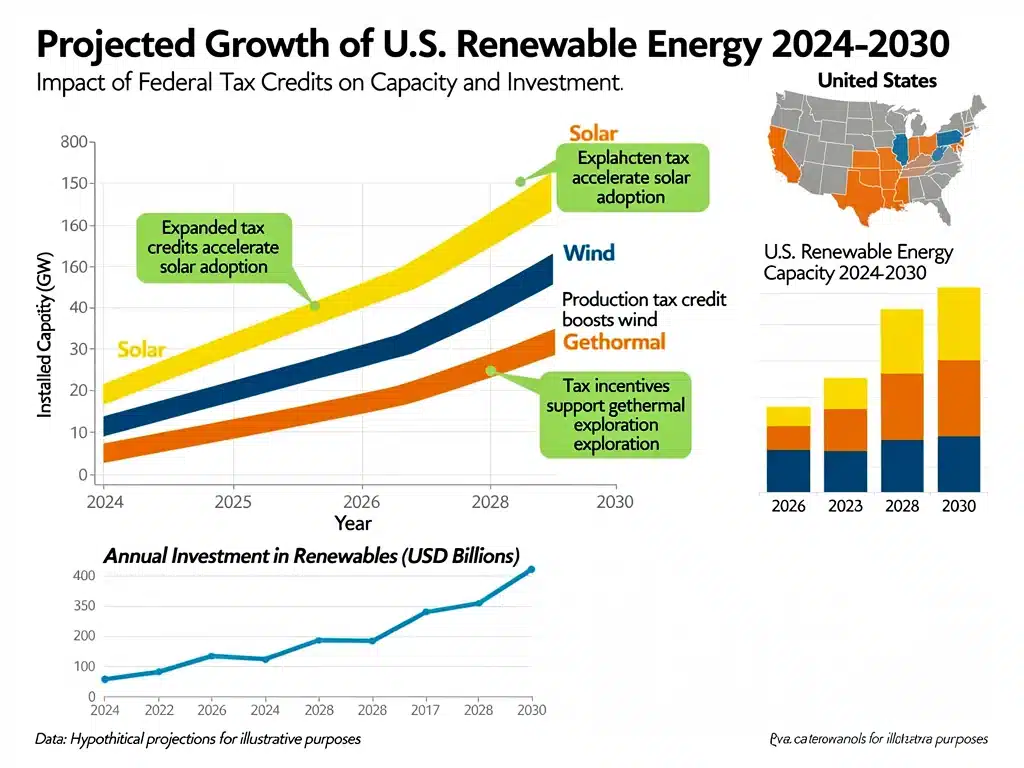
- Solar and Wind Expansion: Expect continued rapid deployment as these mature technologies benefit from extended and stable incentives, driving down costs further.
- Emerging Technologies: Geothermal, hydropower, and advanced nuclear projects will see increased viability and investment, diversifying the nation’s clean energy portfolio.
- Energy Storage: Standalone energy storage projects, critical for grid stability and renewable integration, are also explicitly eligible for the ITC, fostering significant growth in this vital area.
This broader approach is anticipated to foster greater competition and innovation across the clean energy industry.
Developers will have more flexibility to choose the most efficient and cost-effective technologies for their specific projects, leading to optimized outcomes and accelerated decarbonization.
Driving Investment and Economic Growth
The 2026 Clean Energy Tax Credits are designed to unleash a wave of private sector investment into the U.S. renewable sector.
By providing predictable and substantial financial incentives, the legislation makes clean energy projects more attractive to capital, both from established players and new market entrants.
According to recent economic projections, these credits could stimulate hundreds of billions of dollars in new investment over the next decade.
This influx of capital is expected to fuel job creation across the entire clean energy supply chain, from manufacturing and installation to research and development.
The emphasis on domestic content and energy communities ensures that the economic benefits are distributed broadly, supporting local economies and addressing historical inequities.
This strategic approach aims to build a robust, self-sufficient clean energy economy within the United States.
Boosting Domestic Manufacturing and Supply Chains
The bonus credit for domestic content is a powerful incentive for companies to onshore manufacturing and strengthen U.S. supply chains for clean energy components.
This move is critical for national energy security and economic resilience.
- Component Production: Increased production of solar panels, wind turbine components, battery cells, and other critical materials will reduce reliance on foreign suppliers.
- Skilled Workforce Development: Investment in domestic manufacturing will necessitate a skilled workforce, leading to new training programs and job opportunities in high-tech sectors.
- Economic Multiplier Effect: Local manufacturing facilities will create an economic multiplier effect, supporting ancillary businesses and contributing to regional economic vitality.
This policy aims to create a virtuous cycle where increased domestic demand for clean energy components drives further investment in U.S. manufacturing capabilities.
This strategic alignment is crucial for long-term sustainable growth and a competitive global position.
Impact on Grid Modernization and Energy Storage
Modernizing the U.S. electricity grid is paramount for integrating a higher share of intermittent renewable energy sources.
The 2026 Clean Energy Tax Credits play a crucial role in this effort, particularly through incentives for energy storage and grid infrastructure upgrades.
The explicit inclusion of standalone energy storage in the Investment Tax Credit marks a significant policy advancement.
This will accelerate the deployment of battery storage systems, which are essential for balancing the grid, ensuring reliability, and maximizing the value of renewable generation.
Furthermore, while not directly addressed by the tax credits, the increased deployment of renewables will necessitate corresponding investments in transmission and distribution infrastructure.
The enhanced financial viability of renewable projects will indirectly support these crucial grid modernization efforts.
Accelerating Battery Storage Deployment
The eligibility of standalone energy storage for the ITC is a transformative development. This policy change recognizes the critical role storage plays in a high-renewable grid, moving beyond simply co-locating storage with generation.
- Grid Stability: Battery storage provides essential services like frequency regulation and voltage support, enhancing overall grid stability and resilience.
- Peak Shaving: Stored energy can be discharged during periods of high demand, reducing the need for expensive and often fossil-fuel-intensive peaker plants.
- Renewable Integration: Storage enables better utilization of intermittent renewables by capturing excess generation and dispatching it when needed, smoothing out supply fluctuations.
This focused incentive for energy storage will likely lead to rapid advancements in battery technology and deployment, fundamentally reshaping how electricity is generated, distributed, and consumed across the nation.
Challenges and Implementation Hurdles
While the 2026 Clean Energy Tax Credits offer immense potential, their successful implementation is not without challenges.
Navigating complex regulatory requirements and ensuring adequate workforce development are critical hurdles that need to be addressed.
The sheer scale of the envisioned clean energy build-out will place significant demands on supply chains, raw material availability, and permitting processes.
Streamlining these procedures while maintaining environmental standards will be crucial for meeting deployment targets.
Moreover, ensuring that the benefits of these credits reach all communities, particularly those most impacted by climate change and economic transitions, requires careful planning and equitable distribution mechanisms.
Effective Clean Energy Tax Credits are Reshaping the U.S. Renewable Sector demands acknowledging these complexities.
Workforce Development and Permitting Bottlenecks
The rapid expansion of the renewable energy sector will require a substantial increase in skilled labor. Developing comprehensive training programs and educational pathways is essential to meet this growing demand.
- Skilled Trades: A significant need for electricians, technicians, and construction workers trained in renewable energy installation and maintenance.
- Engineering and R&D: Continued investment in higher education and research to drive innovation and optimize clean energy technologies.
- Permitting Reform: Streamlining federal and state permitting processes without compromising environmental review is critical to avoid project delays.
Addressing these workforce and permitting challenges proactively will be key to unlocking the full potential of the 2026 Clean Energy Tax Credits and ensuring a smooth transition to a clean energy economy.
Environmental and Societal Benefits
Beyond economic incentives, the primary goal of the 2026 Clean Energy Tax Credits is to significantly reduce greenhouse gas emissions and combat global warming.
By accelerating the adoption of renewable energy, the policy contributes directly to national and international climate targets.
The shift away from fossil fuels will also lead to substantial improvements in air and water quality, resulting in better public health outcomes.
Reduced pollution translates to fewer respiratory illnesses and a healthier environment for communities across the U.S.
Furthermore, increased energy independence and resilience are significant societal benefits. A diversified energy portfolio, less reliant on volatile global fuel markets, enhances national security and protects consumers from price fluctuations.
This comprehensive Clean Energy Tax Credits are Reshaping the U.S. Renewable Sector highlights these multifaceted advantages.
Reducing Carbon Emissions and Improving Public Health
The large-scale deployment of clean energy technologies directly displaces electricity generation from fossil fuels, leading to a measurable reduction in carbon dioxide and other harmful emissions. This is a critical step in mitigating climate change.
- Air Quality: Less reliance on coal and natural gas power plants means fewer emissions of particulate matter, sulfur dioxide, and nitrogen oxides, improving air quality in urban and industrial areas.
- Water Conservation: Many renewable energy technologies, particularly solar PV and wind, require significantly less water for operation compared to thermoelectric power plants, conserving vital water resources.
- Climate Resilience: A decentralized and diversified energy system built on renewables is inherently more resilient to extreme weather events and physical attacks than a centralized fossil fuel infrastructure.
These environmental and public health benefits underscore the long-term value proposition of the 2026 Clean Energy Tax Credits, extending far beyond immediate economic gains.
Long-Term Outlook and Future Policy Directions
The 2026 Clean Energy Tax Credits are not merely a short-term stimulus but a foundational policy designed to guide the U.S. renewable sector for years to come.
Their long-term nature provides the stability needed for sustained growth and technological advancement.
Looking ahead, future policy directions may focus on refining these credits based on market response and technological evolution. Continued emphasis on research and development, particularly in areas like advanced energy storage, carbon capture, and green hydrogen, will be crucial.
The success of these credits will also inform international climate policy, positioning the U.S. as a leader in clean energy innovation and deployment.
This ongoing Clean Energy Tax Credits are Reshaping the U.S. Renewable Sector will continue to evolve as the sector matures.
Adaptability and Continuous Innovation
The technology-neutral approach of the credits allows for future flexibility as new clean energy solutions emerge. This adaptability ensures the policy remains relevant even as the energy landscape evolves.
- Emerging Technologies: Future iterations of policy may include specific incentives for nascent technologies that demonstrate significant potential but require additional support to scale.
- Performance-Based Incentives: A potential shift towards more performance-based incentives could further drive efficiency and innovation in renewable energy projects.
- Global Collaboration: The U.S. experience with these tax credits will provide valuable lessons for other nations seeking to accelerate their own clean energy transitions, fostering international collaboration and shared best practices.
The long-term outlook for the U.S. renewable sector, bolstered by the 2026 Clean Energy Tax Credits, is one of dynamic growth and continuous innovation, paving the way for a more sustainable and resilient energy future.
| Key Point | Brief Description |
|---|---|
| Policy Shift | 2026 Clean Energy Tax Credits introduce technology-neutral incentives. |
| Investment Boost | Expect significant private sector investment and job creation. |
| Domestic Focus | Incentives for domestic content and energy communities promote local growth. |
| Grid Modernization | Support for energy storage crucial for grid stability and renewable integration. |
Frequently Asked Questions About 2026 Clean Energy Tax Credits
The primary changes include making the Investment Tax Credit (ITC) and Production Tax Credit (PTC) technology-neutral, meaning they apply to any zero-emission electricity generation. They also offer bonus credits for domestic content and projects in energy communities, alongside direct pay options for non-taxable entities.
These credits are expected to significantly boost investment across the renewable sector, accelerating the deployment of solar, wind, geothermal, and energy storage technologies. This will drive down costs, foster innovation, and create numerous jobs, reshaping the market towards cleaner energy sources.
The technology-neutral approach encourages a wider array of clean energy solutions beyond traditional solar and wind. It promotes innovation by supporting any zero-emission technology, including emerging ones, leading to a more diversified and resilient clean energy portfolio for the nation.
Bonus credits are provided for projects that use domestically manufactured components or are located in designated energy communities. This aims to incentivize the reshoring of manufacturing, strengthen U.S. supply chains, and create high-paying jobs in regions transitioning from fossil fuel industries.
By accelerating the widespread adoption of renewable energy and reducing reliance on fossil fuels, the 2026 Clean Energy Tax Credits are a critical tool in reducing greenhouse gas emissions. This directly contributes to national climate goals and global efforts to combat warming, improving environmental health.
Looking Ahead: The Reshaping of the U.S. Renewable Sector
The 2026 Clean Energy Tax Credits mark a decisive moment for the U.S. renewable sector, setting the stage for unprecedented growth and transformation.
Their comprehensive design, focusing on technology neutrality, domestic production, and equitable distribution, provides a robust framework for decarbonization.
Homeowners and businesses looking to claim these incentives can review official guidelines via the IRS Residential Clean Energy Credit.
Continued monitoring of implementation and market response will be key to understanding the full extent of this policy’s impact on climate goals and economic development, solidifying the U.S. position as a leader in the global clean energy transition.